
Elevation Survey Before Raising, Rebuilding, or Expanding a Coastal Home
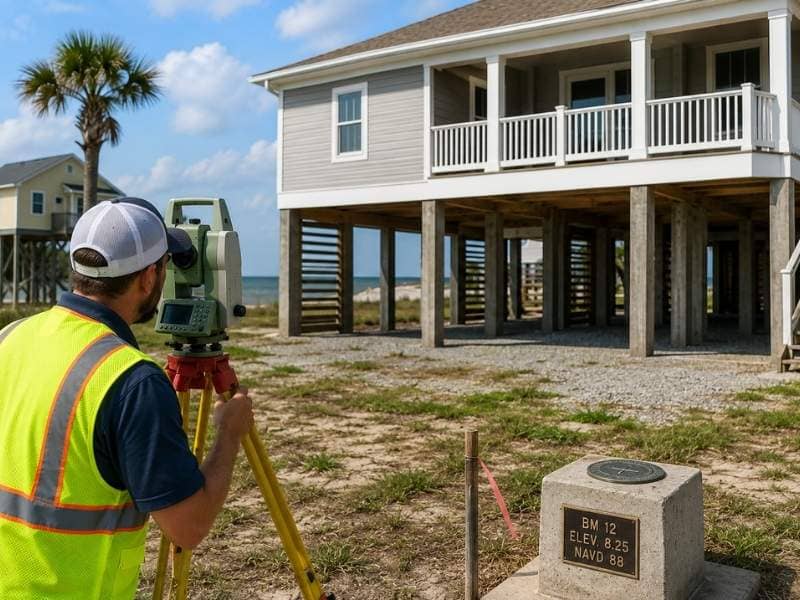
Homes near the coast face problems that other homes don’t. Floods, storms, and strong winds can damage these homes. Before lifting, fixing, or adding onto a coastal home, an elevation survey gives homeowners the height information they need. Without it, big decisions get made without all the facts.
Why an Elevation Survey Is Important Before Raising a Coastal Home
An elevation survey measures how high a home sits above a fixed starting point. Surveyors call that starting point a datum. They use it to make sure all height readings mean the same thing from one property to the next.
Before a home gets lifted, a surveyor checks the height of the lowest floor and the ground around the house. Each number matters when planning how high to raise the structure. Without those numbers, the lift might not go high enough to protect the home from flooding.
Coastal areas face storms that push water onto land. Raising a home without accurate height data can leave it still too low after the work is done. Surveyors take these readings so homeowners and builders know what they are working with.
These measurements also go into a document called an Elevation Certificate. It records how high a home sits compared to the expected flood level in that area. Many lenders and insurance companies ask for this certificate before they work with coastal homeowners.
How an Elevation Survey Helps Homeowners Rebuild After Storm Damage
After a big storm, the ground around a home can shift or wash away. The house itself might move or settle lower than before. Before fixing anything, a new elevation survey shows how the storm changed the property.
In many coastal areas, a home that gets badly damaged has to be rebuilt to meet current height rules. Without a survey, it can be hard to know what those rules require. It can also be hard to know if the home is already too low.
A survey done after storm damage gives builders a clear starting point. They can see where the home sits now and how that compares to the required height. They also know what the ground looks like before work begins. That saves time and prevents problems that show up later in the project.
A survey also gives homeowners a written record of the damage. That record can help with insurance claims and permit paperwork.
Why an Elevation Survey Should Come Before a Home Addition
Adding a room or building a bigger porch changes the size and sometimes the height of a home. In a flood zone, the new part has to meet the same height rules as the rest of the house. An elevation survey done before the addition starts shows whether the existing home already meets those rules.
Some homeowners learn mid-project that the new part needs to be higher than expected. Fixing that problem in the middle of construction costs more than planning for it from the start.
A surveyor measures the home’s current height, the ground where the addition will go, and the area nearby. Builders use that information to design the addition at the right height. It also helps avoid delays during the permit process. Height information is often part of what officials need to review.
How an Elevation Survey Helps Homeowners Understand Flood Risk
An elevation survey shows how high a home sits compared to the land around it and the expected flood level for that spot. In coastal areas, this tells homeowners how much protection their home has during a bad storm.
A home that sits well above the expected flood level has more of a buffer. A home sitting at or below that level has less. The survey does not say whether a flood will happen. It shows where a home stands compared to the flood levels that have been worked out for that area.
This also affects flood insurance costs. The National Flood Insurance Program uses height data to set rates. Homes that sit higher usually pay less. Homes that sit lower usually pay more. A homeowner without a current survey might not know whether their rate matches their actual risk. A new survey could show that an adjustment is possible.
How Land Surveyors Perform an Elevation Survey for Coastal Homes
A land surveyor starts from a benchmark. This is a fixed point with a known height. From there, the surveyor takes readings at several spots around the property.
For a coastal home, the surveyor checks the lowest floor, the bottom of any attached structures, and the top of the foundation. The ground at several points around the house gets measured too. Each reading gets recorded carefully.
Surveyors use leveling tools and GPS equipment to get accurate readings. On coastal properties, even six inches can change how a home is rated for flood purposes. The tools help make sure the numbers are right.
After the readings are done, the surveyor can put together an Elevation Certificate. This certificate organizes all the height data into a format that banks, insurance companies, and local offices can use. For coastal homeowners, this document is often one of the most useful papers in the whole project.
Frequently Asked Questions
Why should I get an elevation survey before raising my coastal home?
An elevation survey shows how high your home and the ground around it sit right now. That starting point is needed to plan the lift correctly. It also helps create an Elevation Certificate, which many lenders and insurance companies require.
How can an elevation survey help after a hurricane or major storm?
A storm can move a home on its foundation and change the ground around it. A survey taken after the storm shows the current height of the home and what the ground looks like before rebuilding starts. That information helps builders plan the right next steps.
Why is an elevation survey important before expanding a home?
Any addition in a flood zone has to meet height rules. A survey before the project starts shows what height the new part needs to reach. That prevents costly changes once construction has already begun.
How does an elevation survey help homeowners learn about flood risk?
It shows how high your home sits compared to the expected flood level for your area. That gap tells you how much protection you have. It also affects how much you pay for flood insurance through the National Flood Insurance Program.
What does a land surveyor do during an elevation survey?
The surveyor starts from a fixed point with a known height, then measures the lowest floor, foundation, attached structures, and ground at several spots around the home. Those numbers get recorded and can be used to prepare an Elevation Certificate.