
Boundary Survey Before Tree Clearing on a New Homesite
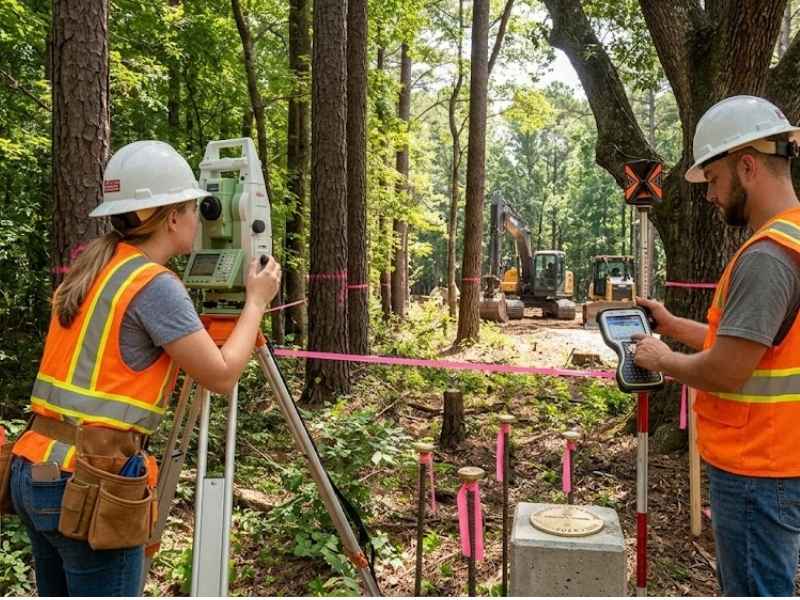
Clearing trees for a new home feels like progress. Before the first tree falls, a boundary survey shows you exactly where your land ends. On a wooded homesite, that line is rarely obvious, and a wrong cut can cost you far more than the survey ever would. A boundary survey marks your true corners and edges so the work stays on your side. With clearly marked lines, you can clear the site with confidence instead of guesswork.
The Real Cost of Cutting Across the Line
Cutting a neighbor’s trees by mistake is one of the most expensive errors in site prep. Mature trees take decades to grow, so they carry real value, and the law tends to protect them. In many places, a court can order you to pay two or three times the value of the trees you removed. A boundary survey settles where your land stops before a single trunk comes down. That single step can keep an ordinary clearing project from turning into an expensive legal dispute.
Mark the Building Envelope, Not Just the Boundary
A boundary line tells you where your property ends, but it does not tell you where the house can go. Local setback rules require your build to sit a fixed distance inside each property line. A surveyor can stake that buildable area, often called the building envelope, along with the spots for the driveway, well, and septic field. When the crew clears those stakes, they open up exactly the space the project needs. Nothing useful disappears under brush, and no important tree falls by accident.
Clear Only What the Plan Needs
Clearing the entire lot is rarely the smartest decision on a wooded homesite. Many mature trees add shade, privacy, and value to a finished home, so keeping the right ones pays off. With your boundary and envelope staked, you can mark a clearing limit and leave the rest standing. The operator follows that line instead of guessing in heavy brush. You end up with an open homesite and the trees you actually wanted to keep.
Stake It Before the Machines Arrive
Heavy equipment moves quickly, and it will not slow down for a line that nobody marked. A dense brush hides corners, so an operator can drift across a boundary without ever seeing it. A surveyor can flag the corners and run a visible clearing line that a machine operator follows at a glance. Bright stakes and ribbon turn an invisible legal line into something real on the ground. That visible line is what keeps a fast crew honest.
A Survey That Carries Into Construction
A boundary survey is not a one-time expense you forget after clearing. The same staked corners and lines feed your permit application, your setback checks, and the later staking for the foundation. Building officials want to see that your plans respect the property lines, and a current survey answers that question. When you build on a base of verified lines, fewer surprises stall the schedule. A single accurate survey early in the process can prevent several expensive rounds of rework later.
Frequently Asked Questions
What is timber trespass?
Timber trespass is the legal term for cutting or removing trees that belong to someone else. It often happens when a property line is unclear and clearing crosses onto a neighbor’s land. Because mature trees are hard to replace, courts can treat the act as a serious and costly mistake.
Who is responsible if I clear past my property line?
As the property owner, you are usually responsible for clearing that crosses the line, even if a hired crew did the cutting. The neighbor can seek payment for the lost trees and any related damage. A boundary survey before the work begins is the simplest way to avoid that risk.
Should I stake my boundary before clearing?
Staking your boundary before clearing gives the crew a clear line they can actually see. Wooded corners are easy to miss, so flags and ribbon prevent costly mistakes in heavy brush. The small cost of staking is far less than the price of cutting the wrong trees.
Can a boundary survey mark my building setbacks?
Yes, a surveyor can locate your property lines and then mark the setbacks required for your build. Those marks show the true area where the house, driveway, and other features can sit. With the envelope staked, you clear and build in the right place from the start.
Will tree clearing disturb my property corners?
Heavy equipment can knock out or bury the markers that fix your corners. Once a corner is lost, confirming your boundary again takes extra time and money. Marking and protecting corners before clearing keeps those reference points safe.
Does a boundary survey work for permits and construction?
Yes, a boundary survey supports both the permit stage and the building stage that follows. Officials use it to confirm that your plans respect the property lines and setbacks. The same survey then guides foundation staking, so the work stays inside your boundaries.