
What Is LiDAR Mapping and How Does It Work?
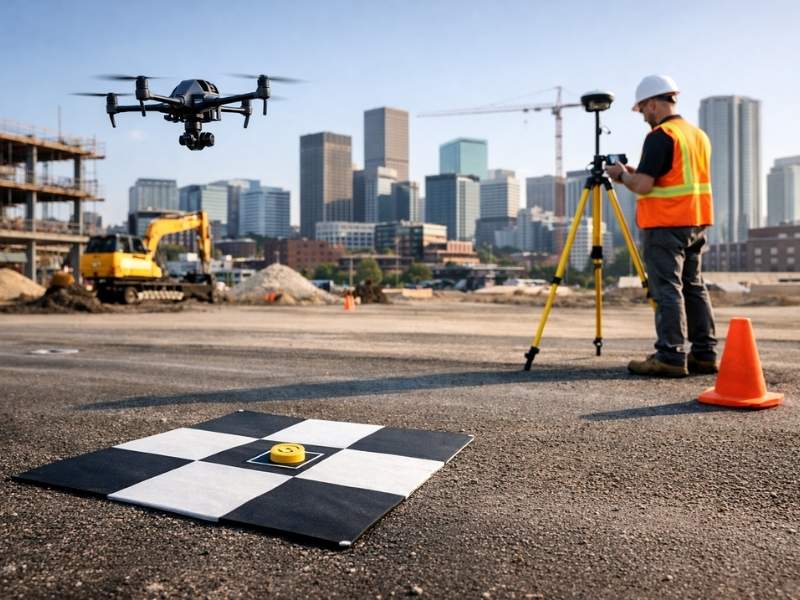
Most developers don’t think about ground data until a project hits a problem. By then, the design is done, the budget is set, and fixing it costs real money.
LiDAR mapping catches those problems early. It scans a property and collects millions of precise measurements before design work begins. The result is a detailed picture of the land that engineers, planners, and surveyors can actually work from.
This article explains what LiDAR mapping is, how it works, and why developers use it before breaking ground.
What Is LiDAR Mapping?
LiDAR stands for Light Detection and Ranging. It uses laser pulses to measure distances between a sensor and the ground.
Each pulse travels down, hits a surface, and bounces back. The sensor records how long that took. Since light moves at a known speed, the return time converts directly into a distance.
Do that millions of times over a property and you get a three-dimensional map of everything on it.
How LiDAR Mapping Collects Data
The sensor mounts on a drone, aircraft, or ground-based tripod. The method depends on the project size.
Drone-mounted LiDAR is the most common choice for land development. The drone flies a planned path over the property. The sensor fires pulses the entire time. The drone’s GPS logs its exact position for every shot, so each measurement ties to a real-world coordinate.
Aircraft and helicopters cover more ground but cost more to mobilize. Ground-based scanners work well for close-range detail work like building interiors or confined sites.
What the Raw Data Looks Like
The raw output is called a point cloud. Think of it as millions of tiny dots floating in 3D space. Each dot is one laser measurement.
A single drone flight over a mid-size parcel can produce tens of millions of points. That file needs processing before anyone can use it.
Software sorts the points by type: ground, trees, buildings, water. Once sorted, the ground points get separated out. That produces a bare-earth model, showing the true shape of the land with everything else removed.
That bare-earth model is what engineers design from.
What LiDAR Mapping Produces
Once processed, the data gets turned into usable deliverables.
A Digital Terrain Model (DTM) shows the bare ground surface. Engineers use it to plan grading, design drainage, and calculate how much dirt needs to move.
A Digital Surface Model (DSM) shows everything above the ground too. Trees, rooftops, power lines. Useful for 3D visualization and obstruction studies.
Contour lines come straight from the terrain model. These show elevation changes across the site and are required for most grading permit submissions.
Orthomosaic maps combine the LiDAR data with aerial imagery. The result is a photo map tied to real geographic coordinates.
Where LiDAR Mapping Fits in a Project
Most developers order LiDAR early, before design starts.
The terrain model answers basic site questions fast. Where does water drain? How steep is the land? How much grading will this project need? Getting those answers early shapes the site plan before the civil engineer charges for redesigns.
During Design and Permitting
Civil engineers pull the DTM into their software to run drainage calculations and road grades. Accurate terrain data from the start means fewer surprises when the permit review happens.
Most permitting offices require contour data with grading plan submissions. LiDAR-derived contours meet that requirement at any interval the engineer needs.
On Large or Wooded Sites
Ground survey crews struggle with thick vegetation. Getting to every part of a wooded site takes time, and some areas are hard to access safely.
LiDAR pulses pass through gaps in the tree canopy and still reach the ground. That means a wooded property gets mapped at the same accuracy as an open one, without clearing anything first.
A drone LiDAR flight can cover hundreds of acres in a single day. A ground crew covering the same area would take weeks.
LiDAR Mapping vs. Traditional Survey Methods
Traditional topographic surveys collect data one point at a time. A crew sets up, takes a shot, moves, and repeats. The work is accurate but slow. The number of measurements depends on how long the crew is on site.
LiDAR collects data continuously. A typical drone LiDAR system collects 200 to 500 points per square meter at standard flight height. That density captures features a traditional survey might miss: shallow swales, gentle grade breaks, small elevation changes between crew shot locations.
Traditional surveys are still required for legal boundary work and construction staking. LiDAR doesn’t replace them. It handles terrain analysis and large-scale mapping where speed and density matter more than legal certification.
Both methods have a place. Smart developers use them together.
Frequently Asked Questions
Is LiDAR mapping the same as a topographic survey?
No. A topographic survey is done by a licensed surveyor in the field. LiDAR mapping is a technology that collects terrain data using laser pulses from above. LiDAR can produce topographic data, but the two are different methods with different legal standing.
Can LiDAR mapping replace a boundary survey?
No. LiDAR maps terrain and surface features. It does not establish legal property lines. A boundary survey requires a licensed surveyor to research deed records, locate corner monuments, and certify the results. The two are often used together on the same project.
How accurate is drone LiDAR mapping?
Under good conditions with proper ground control, drone LiDAR typically achieves vertical accuracy within a few centimeters. For site planning and grading design, that level of accuracy is enough.
What file formats does LiDAR data come in?
The standard formats are LAS and LAZ for point clouds. Processed deliverables are usually DWG or DXF for CAD, or raster files for GIS software. Confirm what formats your engineer needs before the project starts.
How long does a drone LiDAR project take?
Most mid-size parcels can be flown in a few hours. Processing and delivering the final files typically takes a few days to a week, depending on project size and scope.